
When the Coolant Loop Becomes the Lifeline: Liquid Cooling and the New Rules of Data Center Reliability
India’s Data Centers Have Hit a Thermal Wall
Walk into any new AI-ready data center being built in Navi Mumbai, Chennai or Hyderabad, and you will notice something missing: the wall of roaring air handlers that defined the last generation of server halls. The GPUs powering today’s AI training clusters concentrate so much heat into so little space that blowing air across them simply cannot keep up. A single modern AI rack can dissipate more heat than an entire row of servers did a decade ago.
The industry’s answer is to bring the coolant to the chip. Water-glycol mixtures such as PG25 now circulate within centimetres of the processors themselves — through cold plates bolted onto silicon, through rack manifolds, through Coolant Distribution Units (CDUs), and through the Secondary Fluid Network (SFN) that ties the whole system together. Liquid carries heat away far more effectively than air ever could, which is why every major hyperscale and colocation operator in India is now designing around it.
But this shift comes with a quiet consequence that deserves far more attention than it gets: the data center has become a process plant. And in a process plant, reliability lives or dies at the flow-control level — in the valves, manifolds and piping that most people never see.
The Loop Is Only as Reliable as Its Least Reliable Valve
Consider what liquid cooling actually asks of its hardware. Coolant flows continuously, year-round, at elevated pressure, through circuits routed directly above and beside electronics worth crores. A dripping joint in a chemical plant is a maintenance ticket; a dripping joint above a live AI rack is a catastrophe. There is no margin for a valve that weeps at the stem, a manifold with a porous weld, or an elastomer that swells in glycol.
This is why component selection in an SFN cannot be treated as an afterthought to the mechanical design. Each duty in the loop calls for a purpose-matched product:
- Isolation — Isolation butterfly valves on main and branch headers, so sections of the network can be serviced without draining the system
- Balancing — Static balancing valves that distribute flow evenly across CDUs and racks — because an unbalanced loop starves the farthest cold plate first
- Air management — Automatic air vent valves at riser tops and manifold high points, since trapped air degrades heat transfer and accelerates corrosion
- Backflow protection — Dual plate check valves to prevent backflow when pumps stage on and off
- Protection — Y-strainers ahead of pumps, plate heat exchangers and CDU skids, protecting fine cold-plate channels from debris
- Access — Mini ball valves at every drain, fill and instrument point, so commissioning and maintenance never require improvisation
Why Stainless Steel Won the Materials Debate
Early liquid cooling installations experimented with a mix of materials. The industry has largely converged on stainless steel — SS304L and SS316L in particular — for wetted components, and the reasons mirror what pharmaceutical and food plants learned decades ago. Stainless steel does not corrode in water-glycol service, does not shed particles into the coolant, tolerates the temperature swings of thermal cycling, and welds into permanently leak-tight joints. Cleanliness matters more than most people expect: cold plates have fine internal channels, and any material that contaminates the loop eventually ends up blocking them.
This is precisely where STILONN’s history gives us an unusual advantage. We spent our first fifteen years manufacturing hygienic valves for pharmaceutical, biotech, dairy and food plants — industries where internal cleanliness, surface finish and material traceability are audited, not assumed. When we became India’s first manufacturer of SFN valves, we did not have to learn clean stainless-steel manufacturing for a new market. We simply pointed an existing discipline at a new industry.
Prefabrication: The Difference Between Months and Weeks
Indian data center construction schedules are brutal. Operators are racing to add capacity, and the mechanical scope often sits directly on the critical path. The projects that hit their dates are the ones that treat the coolant network as a manufactured product rather than a site-built one.
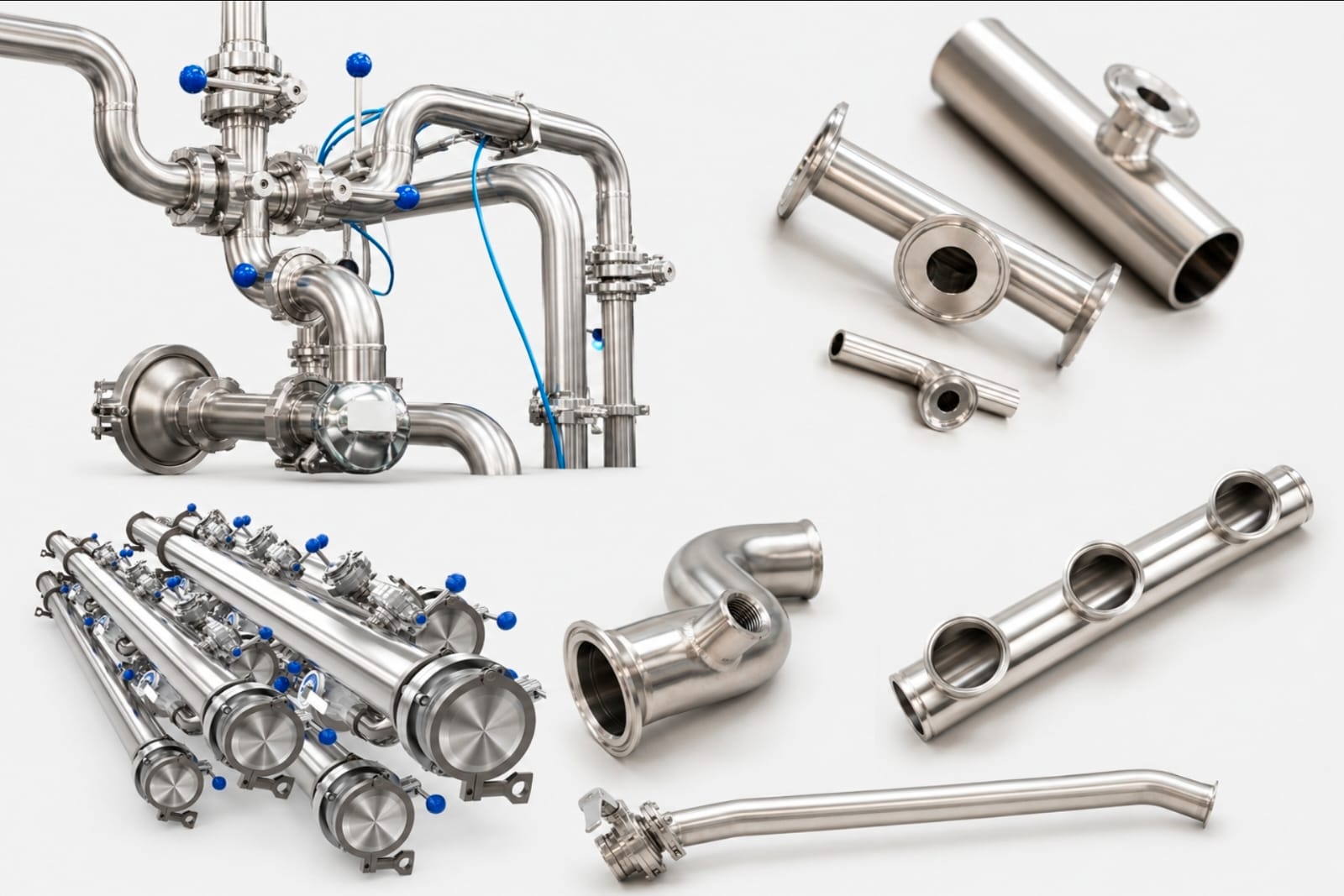
Supply and return manifolds arrive as finished, pressure-tested assemblies with valve stations and instrument tappings already integrated. Pipe spools come cut, orbitally welded and documented from the factory, ready to bolt into place. Complete CDU skid piping packages land on site with their inspection and test records in hand. Every hour of welding moved from a raised floor into a controlled fabrication shop is an hour of schedule risk removed — and a weld made by an orbital TIG machine under documented procedures, not by hand in an awkward overhead position.
At STILONN, this prefabrication scope — manifolds, spools, hoses and skid piping, alongside the valves themselves — is manufactured across our three units near Mumbai, with every assembly hydrostatically tested on SCADA-integrated benches that generate the test report directly from live data. The customer receives not just hardware, but evidence.
What Indian Operators Should Ask Their Flow-Control Supplier
As liquid cooling procurement matures in India, we encourage every operator, OEM and MEP contractor to put these questions to any valve or piping vendor:
- Can you show material traceability — mill certificates and PMI verification — for every wetted part?
- Is every valve pressure-tested before despatch, and can the test report be produced for a specific serial number?
- Are your elastomers proven in water-glycol service, and can you support alternative coolant chemistries?
- Can you supply the complete loop — valves, manifolds, spools, hoses, gaskets — or will the project juggle five vendors?
- What happens after supply: can you support commissioning, and how fast can you replace a component in service?
Suppliers who answer these questions confidently are process-industry manufacturers. Suppliers who cannot are trading companies — and a coolant loop is no place for a middleman.
Built in India, for India’s AI Decade
India’s data center capacity is set to multiply through the rest of this decade, and nearly all of that new capacity will be liquid-cooled. Until recently, the valves and engineered piping behind these systems were largely imported, with the lead times and support gaps that imports imply. STILONN was founded on the belief that India’s most critical infrastructure deserves flow control made in India — designed in our own office, machined and welded in our own plants, tested on our own benches, and supported by engineers a phone call away in Mumbai rather than a continent away.
From CapitaLand and CtrlS to Vertiv, Digital Edge and Reliance Intelligence, the operators building India’s AI infrastructure are already running on STILONN valves. The next frontier of thermal management is liquid — and the loop deserves nothing less than components engineered for it.