
Secondary Fluid Networks (SFN)
Why Liquid Cooling — and Why SFN Matters Now
Artificial intelligence and high-performance computing have pushed rack power densities far beyond what air cooling can handle. Racks that once drew 5–10 kW now routinely exceed 50–100 kW, and modern GPU clusters can only be cooled by circulating liquid directly to the heat source. This shift has created an entirely new category of mission-critical infrastructure inside the data center: the Secondary Fluid Network.
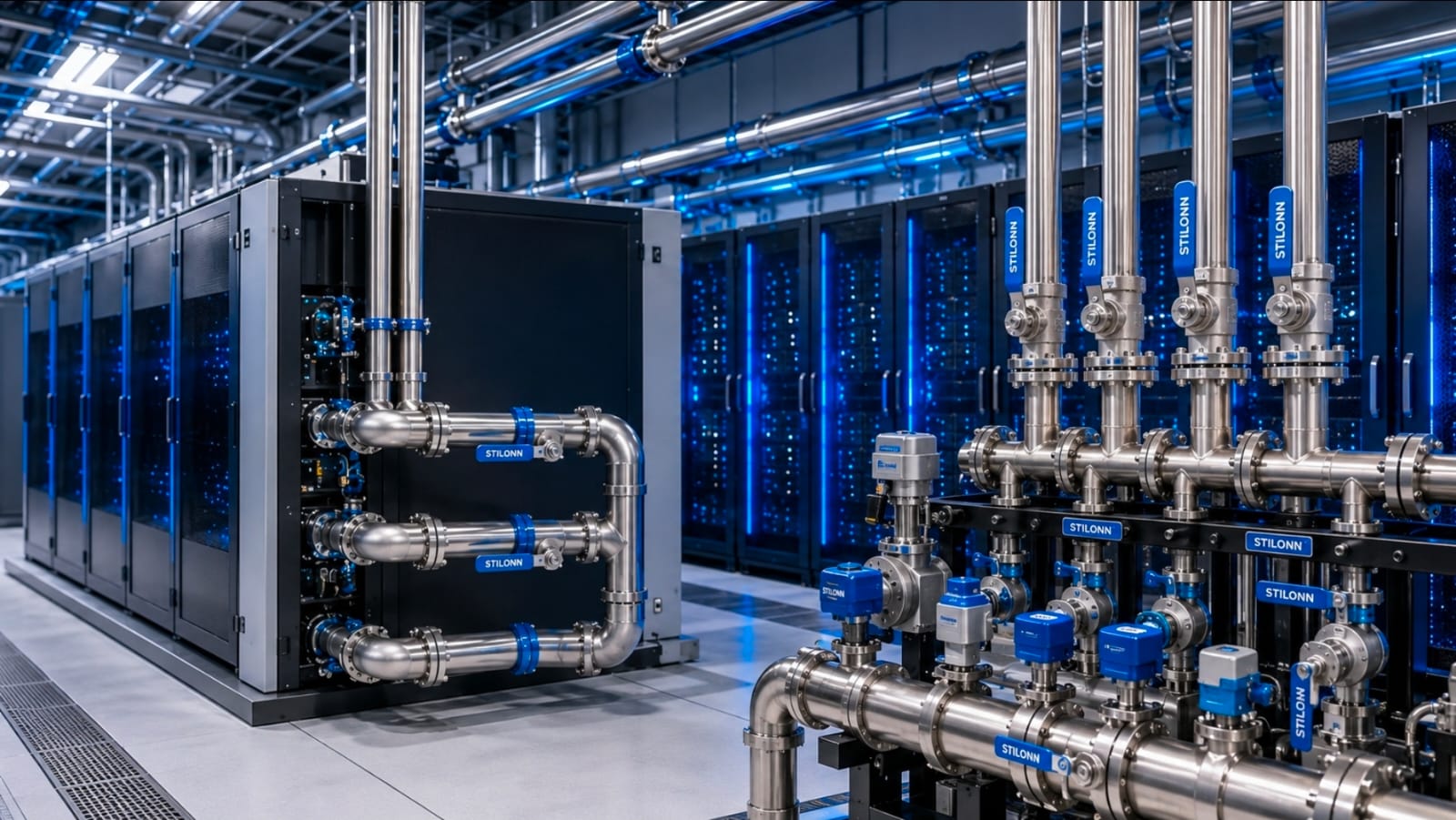
The Secondary Fluid Network (SFN) is the closed-loop piping system that carries treated coolant between the Cooling Distribution Units (CDUs) and the liquid-cooled server racks. Unlike the primary chilled-water loop, the SFN operates in direct thermal contact with sensitive IT hardware. Any contamination, corrosion, leakage, or flow imbalance in this loop can damage servers worth crores of rupees. The SFN must therefore be engineered, fabricated, and maintained to a hygiene standard closer to pharmaceutical process piping than to conventional HVAC.
Anatomy of a Secondary Fluid Network
A well-designed SFN typically consists of:
- CDU supply and return connections — the source and return points of coolant circulation for the entire loop.
- Stainless steel distribution headers — commonly SS304L, Schedule 10S construction, sized to serve multi-megawatt cooling capacity per header run.
- Branch piping into hot aisles — sanitary-grade stainless steel tubing distributing coolant to each row of racks.
- Rack stems with isolation valves — allowing each rack to be connected, isolated, or serviced without disturbing the rest of the network.
- Balancing and flow-setting valves — ensuring each rack receives its designed coolant flow for stable thermal performance.
- Air vent / air bleed valves — installed at high points to eliminate trapped air that would otherwise cause flow noise, cavitation, and hot spots.
- Instrumentation — pressure transmitters, differential pressure points, high-accuracy RTDs on supply and return, and leak-detection sensors at rack and CDU locations.
Modern deployments favour overhead piping routes (eliminating the need for raised floors), colour-coded supply and return lines, and non-proprietary CDU interfaces so operators are not locked into a single equipment vendor.
Materials: Why Stainless Steel Is Non-Negotiable
Coolant chemistry in a liquid-cooling loop (typically a propylene-glycol-based fluid such as PG25) is carefully controlled, and the wetted materials must not compromise it. Industry material guidelines for SFN systems are strict:
Approved wetted materials
- SS304 / SS304L / SS316 / SS316L piping, fittings, and valves
- Peroxide-cured EPDM and PTFE (including PTFE-lined components) for seals and flexibles
- Selected elastomers such as Viton where fluid-compatible
Restricted materials
- Aluminium and magnesium (galvanic corrosion risk)
- High-zinc brass, leaded alloys, and non-stainless steels
- Sulphur-cured elastomers, PVC, and similar incompatible polymers
This is precisely why SFN valves are a distinct product category. A standard industrial valve with a brass stem, carbon-steel body, or sulphur-cured seat has no place in an SFN loop. Every wetted component — body, disc, ball, stem, and seals — must comply with the approved materials list and be fully traceable.
Fabrication, Cleaning, and Quality Standards
SFN infrastructure is built to codes and practices borrowed from hygienic process industries:
- ASME B31.3 — process piping design and fabrication
- ASTM A270 — sanitary stainless steel tubing
- ASTM A380 / A967 — cleaning, descaling, and citric acid passivation of stainless steel
- GTAW/TIG welding, with orbital welding preferred, performed by certified stainless steel welders, with visual and volumetric weld inspection
- DI-water flushing and turbidity-controlled cleanliness validation (target below 1 NTU), followed by controlled drying with instrument-grade air or nitrogen
- Hydrostatic and air pressure testing before coolant charging and commissioning
The result is a piping and valve network that is oxide-free, burr-free, chemically passivated, and verified clean before a single drop of coolant enters the loop — exactly the discipline STILONN has practised for years in pharmaceutical, food & beverage, dairy, and biotech applications.
STILONN: India’s First SFN Valve Manufacturer
STILONN Valves & Controls, an Aeroflex Group company, was built on hygienic and sanitary stainless steel valve manufacturing — the exact DNA that data center liquid cooling now demands. Since 2008 we have grown to three manufacturing units, more than 1,000 SKUs, 900+ customers, and an annual capacity of 120,000 valves, and we are proud to be India’s first manufacturer of SFN valves purpose-built for data center liquid cooling.
Our SFN offering includes:
- SS304L butterfly valves and ball valves for headers, branch lines, and rack stems
- Balancing valves and flow setters for precise thermal balancing across racks
- Air vent valves for high-point venting of the coolant loop
- Strainers and non-return valves for coolant protection and flow security
- Gaskets and sealing solutions compatible with liquid and hybrid cooling chemistry
- Prefabricated stainless steel piping, manifolds, and skid assemblies — supported by our clean-room piping fabrication setup and orbital TIG welding capability
Why data center OEMs and operators choose STILONN:
- Hygienic-grade manufacturing heritage — sanitation-grade practices, material traceability, and PMI verification as standard
- Proven data center supply record — serving leading CDU OEMs, hyperscale operators, and colocation providers across India and the region
- Ready stock and fast delivery — dedicated inventory for liquid cooling projects with short standard lead times
- Aeroflex Group strength — full group backing for large-scale SFN piping and fabrication programmes
Conclusion
As India’s data center capacity multiplies to serve the AI era, the Secondary Fluid Network has become as critical as the servers it protects. Success in this segment demands stainless steel expertise, hygienic fabrication discipline, and valves engineered specifically for coolant service. STILONN brings all three — making us the natural partner for CDU manufacturers, MEP contractors, and data center operators building the next generation of liquid-cooled facilities.